

Disclaimer: By reading this article, you acknowledge and agree to the terms and conditions
I wanted to write a brief update on my position in Oppenheimer Holdings (OPY) and run through the "Value Trade" checklist.
Oppenheimer Holdings is a middle-market investment bank and wealth management firm with a focus on Healthcare, Technology, Municipal Bonds, and “Baby Bond” / Preferred Stock offerings. Over the past two years, its consistently profitable Wealth Management Division has been overshadowed by steep losses in the Capital Markets Division due to slowing M&A and deal flow.
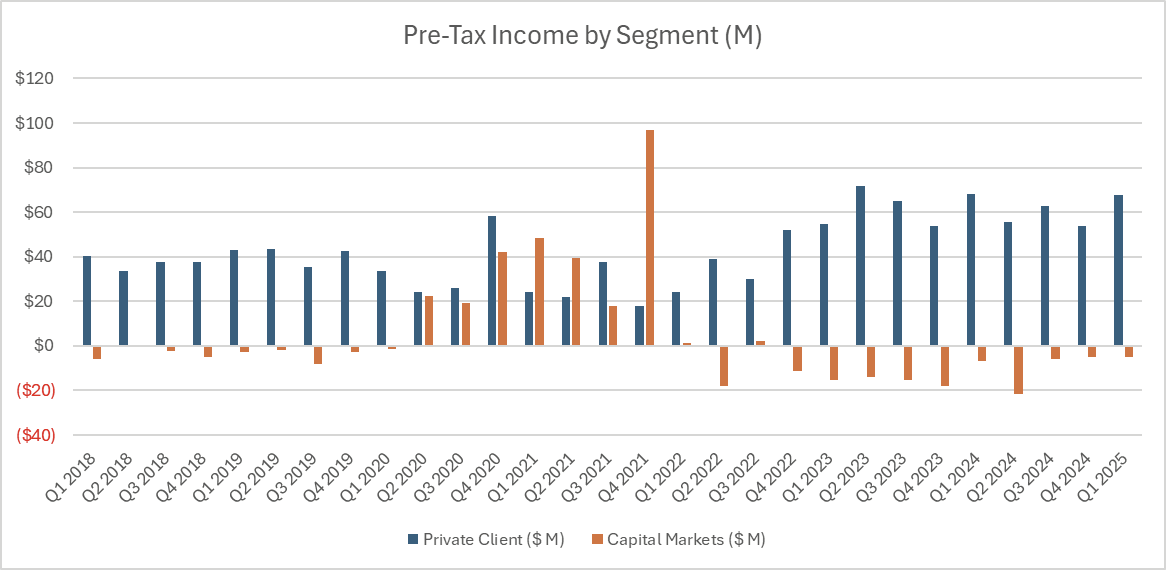
After the small cap / SPAC mania of 2021 faded, Oppenheimer’s Capital Markets Division swung from $30 - $90 Million in quarterly pre-tax profits to $15 - $20 Million in quarterly losses as a result of depressed deal activity and an unfavorable small cap backdrop. Oppenheimer immediately began restructuring, largely pausing new hires in the Capital Markets division and merging the Private Client and Asset Management segments into Wealth Management. The efforts are yielding results - losses in the Capital Markets Division have narrowed from a quarterly $15 - $20 Million in 2023 to just $5 - $6 Million in 2024, and I believe they are on track to turn positive once again in 2025.
Deal flow has picked up considerably in 2025. Oppenheimer was a Joint Bookrunner in the $1.495 Billion QXO secondary and the $126.5 Million American Integrity Insurance IPO in May, and was also a Joint Manager in the Republic of Kyrgyzstan’s $700 Million USD Sovereign Bond in April.
SPAC business is also beginning to pick up. Oppenheimer was the sole placement agent for Helix Acquisition Corp ($260 Million) in March and is the advisor for Southport Acquisition Corp (PORT) who intends to acquire Angel Studios later this year and pursue a Bitcoin Treasury Strategy (nuts - but this is the world we live in).
With massive US trading volumes in Q2 and record breaking Sales and Trading profits reported by Goldman Sachs and Citigroup, I think its likely that Oppenheimer also reports a S&T boon within its Capital Markets Division, and near record retail commissions from client trading activity within its Wealth Management Division.
One of the things I like about Oppenheimer is you have the right-tail “optionality” of the Capital Markets segment combined with steady, predictable, and growing profits from its Wealth Management Division. AUM has been growing at 8% a year since 2018, and profitability has followed closely at 7.5% a year.
Despite the low risk nature of Oppenheimer’s business, it trades at an astounding discount to peers and the broader financials index. The current valuation of just 9x 2024 earnings implies it carries the risk of a bank ridden with credit issues or an insurer with massive catastrophe risk, except its core businesses, Wealth Management and Investment Banking, are fee-based lines with minimal downside risk.
Aside from its small portfolio of client margin loans going bad, the only way Oppenheimer can truly “blow up” is by overpaying its employees and intentionally running the company into the ground.
Now, let’s quickly walk through our “Value Trade” checklist to see if the valuation is compelling:
“Quality of the Business and Consistency of Earnings”
Oppenheimer’s fee-based model significantly reduces downside risk. While Investment Banking advisory fees and Wealth Management charges are obviously tied to stable rising markets, its important to understand Oppenheimer is not directly “playing the market” like an insurer via investment portfolio risk, or a bank via credit risk. Even during the depths of the 2009 crisis, Oppenheimer only lost $1.72 a share in 2008 and rebounded to profitability in 2009.
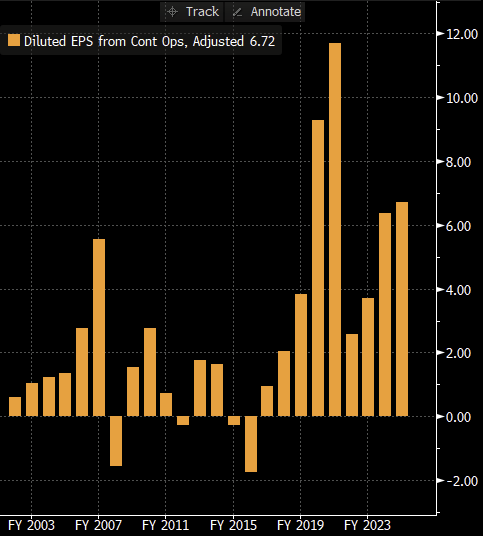
Profits from the Wealth Management Division are stable, growing, and primed for further expansion as overall Asset Under Management are boosted by record market valuations.
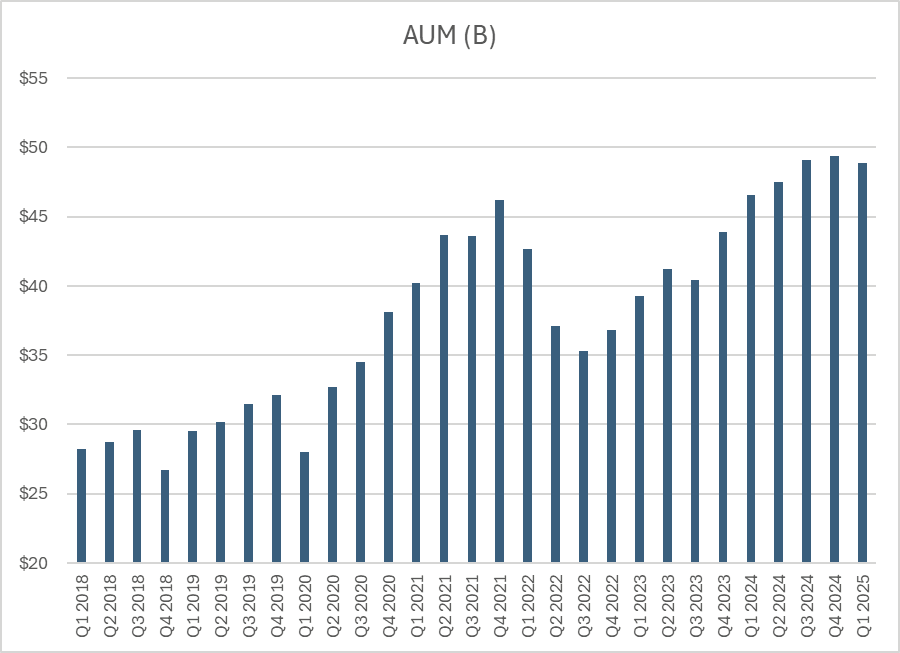
While Oppenheimer doesn’t carry the prestige or wow-factor of the Bulge Bracket banks, it’s respected within Healthcare, Technology, and Municipal Securities. It’s carved a niche within Banking, and given the consistency from its Wealth Management Division and the upside optionality from its Capital Markets division I think it’s fair to say the earnings are consistent and high quality.
“Insider Alignment and Management Expertise”
The Insiders are sufficiently aligned, with Albert Lowenthal (founder of the company) and his son Rob Lowenthal (New CEO) owning 3.5 Million shares ($238 Million of the company, approximately 32%).
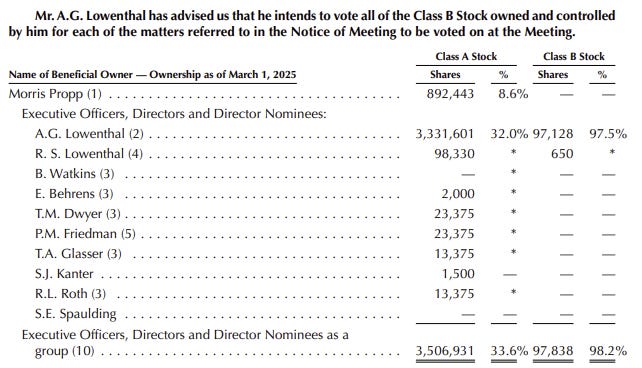
They do take a relatively high salary of $10.5 Million, including significant Non-Equity Incentive Compensation.
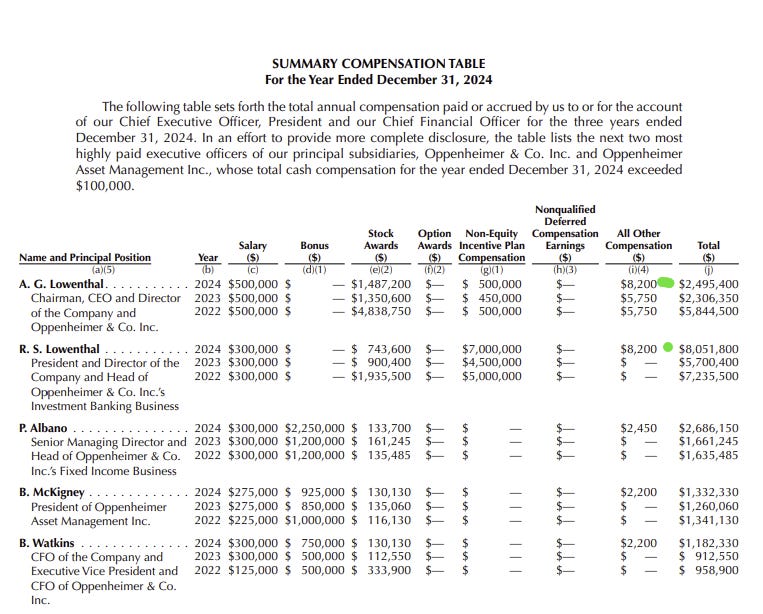
Although I am never pleased to see large compensation, in the context of Investment Banking, nearly a quarter Billion of insider ownership, and a 5-Year Total Return of (242%) along with a 10-Year Total Annualized Return of 13.98% vs 13.41% on the S&P 500, I’m willing to overlook this. A lot of the Non Equity Incentive Compensation is tied directly to a rising stock price, which is much more preferable than a large base cash salary.
“Capital Allocation”
Management has demonstrated acceptable capital allocation. Oppenheimer has reduced the share count by roughly 20% since 2021, repurchasing significant quantities of stock at a deep discount to Tangible Book Value which has naturally been very accretive to EPS and Tangible Book Value per share.
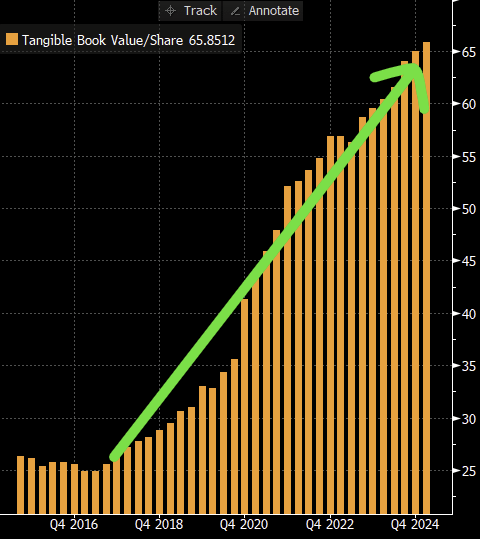
Since Oppenheimer is trading right around likely quarter end Tangible Book Value of $67 and has a clean balance sheet (no debt) and plenty of cash, I’d like to see them get more aggressive with share repurchases.
However, the company incentivizes employees with 2.6 Million cash settled OARs (Oppenheimer Appreciation Rights) - payouts directly tied to appreciation in the stock price. In 2024, the company recorded a $32.6 Million compensation charge due to the 55% increase in the share price, and even admitted a rising stock price dented earnings
Our reported results were negatively impacted (with full year expense totaling $32.6 million pre-tax) by the increase in our stock price in 2024 and its conversion to expense in certain liability awards previously made to employees, making the recent recognition of our stock by investors, a mixed blessing.
I’m not going to rake Oppenheimer through the coals over not repurchasing more shares. The Capital Allocation might not be elite, but it’s certainly acceptable and well within the ordinary for an investment bank.
“Reading the Tea Leaves”
Given record market valuations, an improving Capital Markets backdrop, and significant trading activity in Q2, I think Oppenheimer is likely to beat the 2024 Q2 figure of 92 cents and is too cheap to ignore at 9x Trailing Earnings and 1.05x Tangible Book Value.
The rise in Oppenheimer’s stock price might dent earnings due to a compensation charge associated with the earnout shares, but that’s acceptable to me. Unlike ridiculous stock based compensation at tech companies, if the guys at Oppenheimer get a nice bonus (as they did in 2024 when the stock was up 55%) because the price is rising, I’m happy for them.
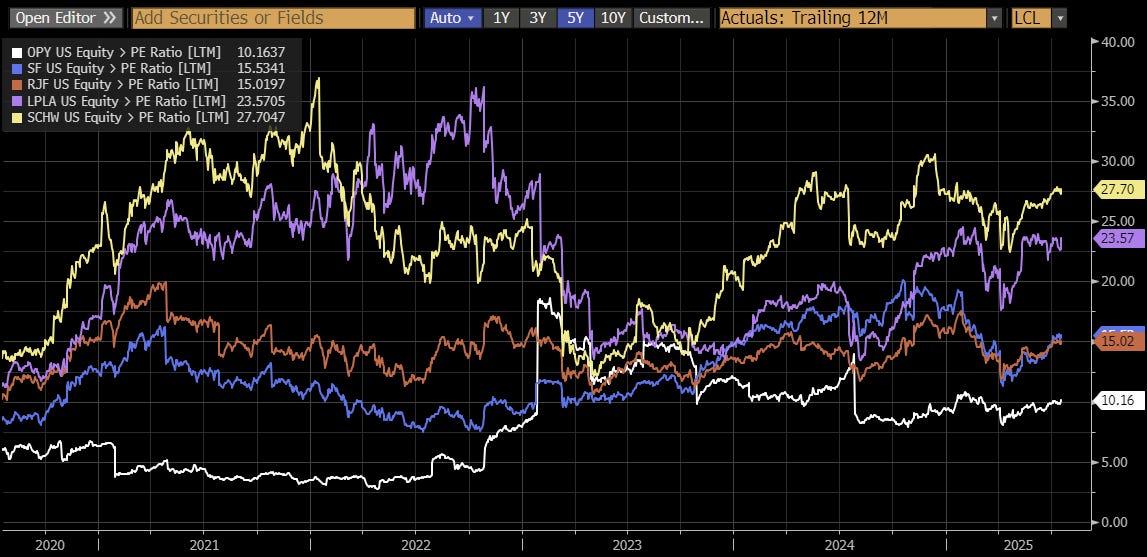
Oppenheimer trades at a steep discount to peers. I think a lot of this discount is due to lower liquidity (as a result of high insider ownership) and lower awareness given there no equity research coverage.
If the Wealth Management Division was valued similarly to LPLA or Stifel, I think Oppenheimer could be valued at $80 - $90 a share. Oppenheimer would also be an attractive acquisition target for a Middle Eastern or Asian Investment bank given its large Private Client base, the fact it self clears its own trades, has a clean balance sheet, and a niche foothold in Technology, Healthcare, and Municipal Banking.
It’s always easier to buy at a discount to Tangible Book (low 60s), but I think there is still upside at the current price. Excluding the OAR payouts from last year, Oppenheimer would’ve made close to $9 a share (putting it at 7.5x “Adjusted Earnings”) and I anticipate performance this year will be even stronger.
Oppenheimer rose from $59.63 at the end of April to $65.77 at the end of June, which will negatively impact earnings by about $1.00 a share as a result of the appreciation of the OARs. Given this headwind, if Oppenheimer is still able to handily beat last year’s $0.92 figure I think the rally could accelerate.
I’m not banging the table on Oppenheimer given the recent run up and uncertainty around earnings (OAR accounting is difficult). Nonetheless, if you are bullish on Capital Markets activity, Oppenheimer is an undervalued name that should be on your radar.