

Disclaimer: By reading this article, you acknowledge and agree to the terms and conditions
It’s been almost three months since the last Portfolio Review on June 12th, but it feels like a lifetime has passed by and that things are crazier than ever, doesn’t it?
The craziness isn’t merely anecdotal, it’s evident in the indices: S&P 500 sectors continue to trade like warring factions rather than correlated, friendly peers.
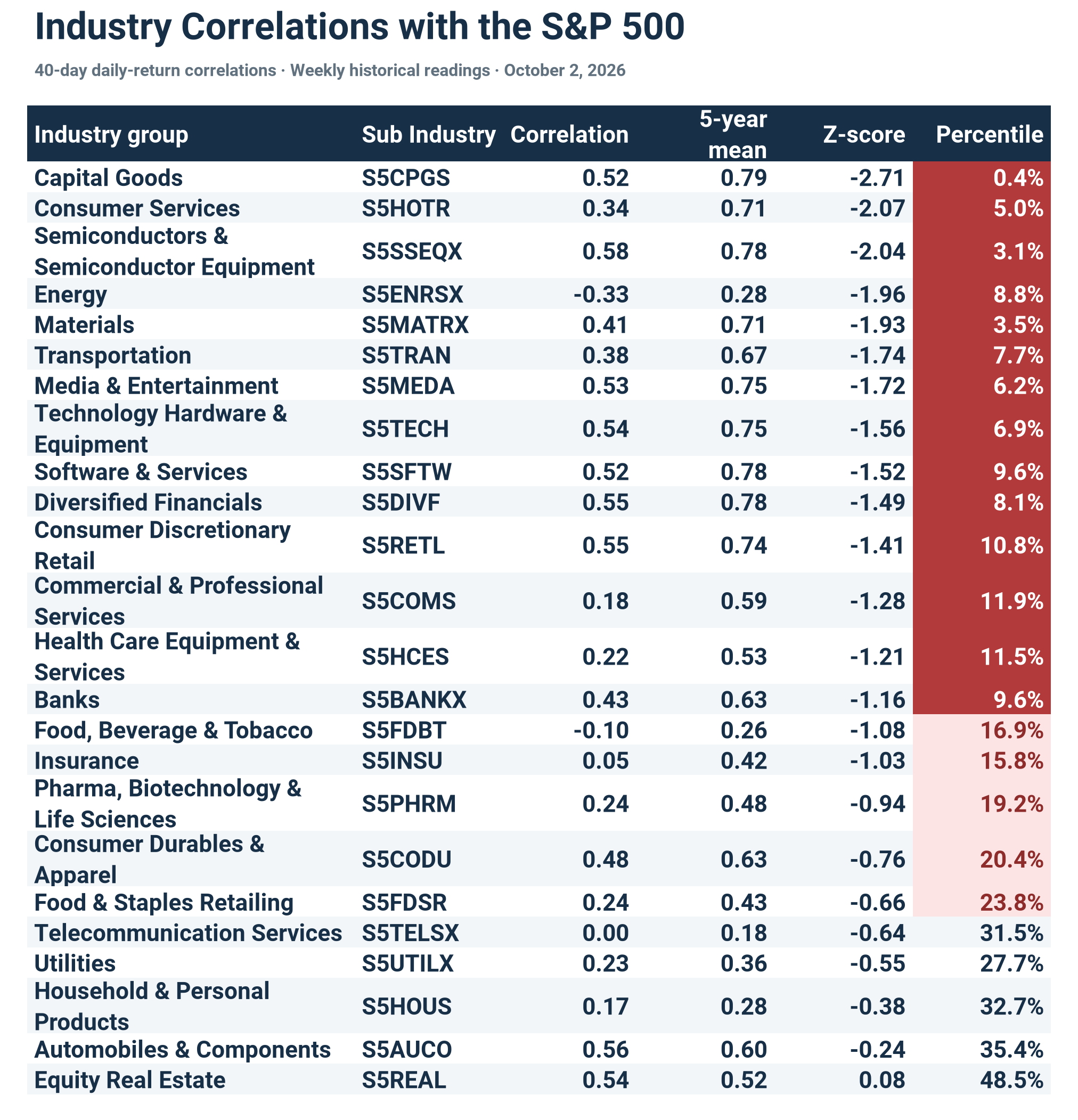
Some of the correlations are a result of “sensible” connections, for example rising Crude Oil prices helping the Energy Sector at the expense of everyone else. Still, with historical correlations between the Consumer Staples, Consumer Discretionary, Semiconductors, Banks, and Financial Sectors to the S&P coming in below the 10th percentile, it’s evident that a lot is going on beneath the surface of a relatively calm S&P 500 performance, especially as crowded AI exposure across pod shops and trading desks amplifies these swings through repeated cycles of grossing up and panic-induced selling.
Take, for example, the 15% surge in Regional Banks and Insurance during the late-June to mid-August “flight to safety” as the Memory Sector and Nvidia imploded 15-30%. Did the liquidation of the AI trade lead to a change in fundamentals that made Regional Banks and Insurers justifiably worth 15% more? Of course not, and the knee-jerk move up provided an excellent opportunity to exit overvalued financials names before the trend quickly reversed in September (as we’ll discuss further in the Portfolio Review).
As ironic as this sounds, I think the craziness is coming from a logical place. Countless traders and investors have reasonably concluded the World is changing at an ever-increasing pace, and this has prompted them to believe there’s only limited time to “escape the permanent underclass” and take outsized risk to do so. I don’t believe this is the right thing to do, but the graphs below illustrate where they are coming from.
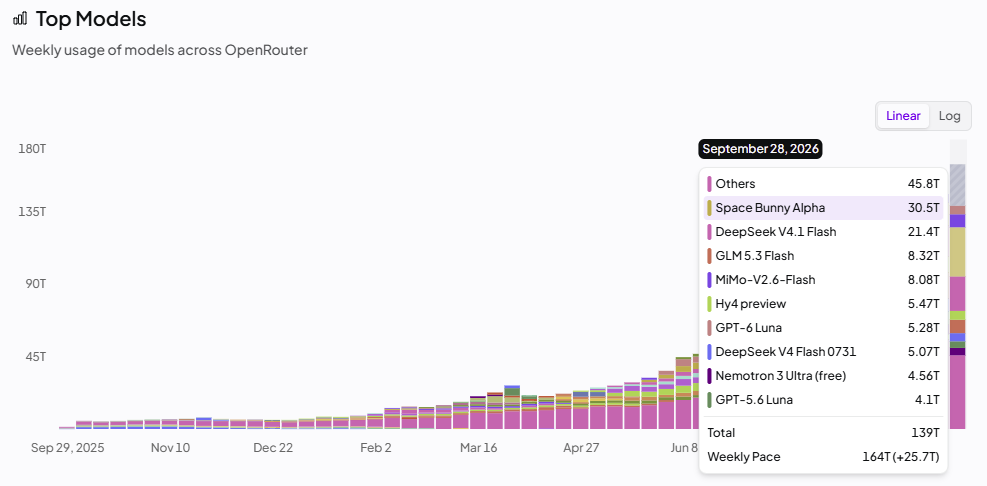
Source: OpenRouter
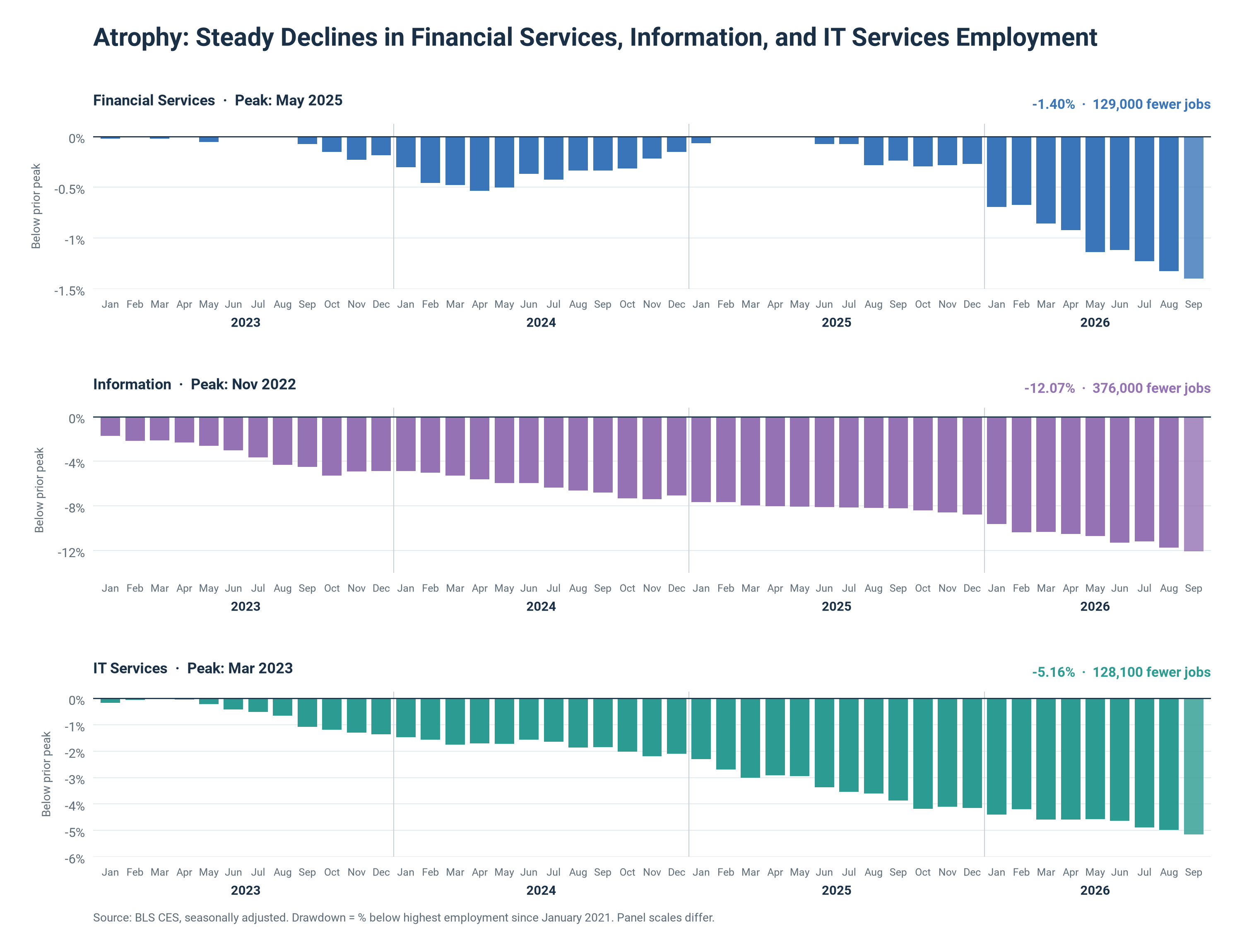
Source: BLS Data (Courtesy of ChatGPT)
Token usage continues to inflect higher. OpenRouter is a platform that gives developers access to hundreds of leading models via a unified API (Application Programming Interface). Their reports regularly reflect 15-20% increases in weekly token usage, which I believe shows just how fast things are accelerating. This isn’t a monthly or quarterly figure, it’s weekly. AI is getting larger, and it’s getting larger quickly.
On the other hand, US employment reports continue to paint a gloomy picture. While the bond market and US Equity Investors gleefully cheer Friday’s NFP miss as lower yields increase their paper wealth (yields promptly reversed), employment within Financial Services, Information, and IT Services continues to slowly decline, with the 2026 YTD decline in Financials employment being the most significant decline in the last 10 years outside of the Wuhan Flu.
Some might quickly say “this is a natural adjustment to the COVID hiring spree” or “these organizations were already bloated”, and that is probably partially true, but there are also clearly structural changes at work.
Ask any investment banker about Rogo, or any Big Four accountant about Internal AI usage. What were previously glitchy and incompetent AI tools now operate at the level of an entry level analyst. They aren’t perfect, obviously, but they are advancing at breakneck speeds and enabling more seasoned employees to get much more done. The sheer payoff for products that work is exactly why Wall Street and VCs are willing to throw hundreds of Millions at any startup that offers an edge.
AI bears frequently cite the “looseness” of these investments and the large number of middlemen within the AI supply chain as evidence it’s one giant bubble, and they’re partially right. Oracle, Google, Microsoft and Amazon are renting out chips at a 25-40% margin, purchased from Nvidia who makes a 70% gross margin, who buys components and memory from suppliers at an astounding 80% gross margin. So many layers of middlemen at 50-80% gross margins, it makes the US Healthcare system look relatively well behaved in comparison.
While your first thought might be this is indicative of a bubble, perhaps it’s also an indication that the payoff of genuinely helpful AI far exceeds its cost, which is why people are willing to invest so much and overpay in the first place. Over the past several months, nearly every hyperscaler and neocloud has raised prices, AWS with a 15% increase this month, Coreweave with a 20% increase in July followed by a smaller increase this month, and Nebius with sizeable increases in May (and also likely this month). I’m not here to say the Frontier Lab business model works (I really don’t know and if anything I lean towards no), but from overall token usage and outsized demand for inference to run open source Chinese models, it seems clear the benefit AI provides far exceeds the cost, which is why anyone with capacity quickly sells out.
Now, the question is, aside from a direct exposure to AI names, how can we benefit from this trend investing-wise? I think the answer is simple: keep a diversified Portfolio of companies at attractive multiples returning cash to the shareholders that are insulated from AI, and simply steer clear of AI challenged names no matter how cheap they may seem.
I think my February 3rd piece on positioning for upside illustrates this well. At the time, a basket of vulnerable software-heavy BDCs were trading at “the largest discount since the financial crisis”, and IES Holdings (an electrical and infrastructure contractor that designs, fabricates, and installs power and communications systems) was trading at a steep discount to industry peers. Both seemed relatively inexpensive relative to historical multiples and invited attention. The software-heavy BDCs, however, were heavily AI vulnerable and had capped upside (who wants to pay above NAV for software loans?) while IES was at an already palatable 17x earnings multiple with sizable insider ownership and 30% growth, and had upside potential if infrastructure investment accelerated.
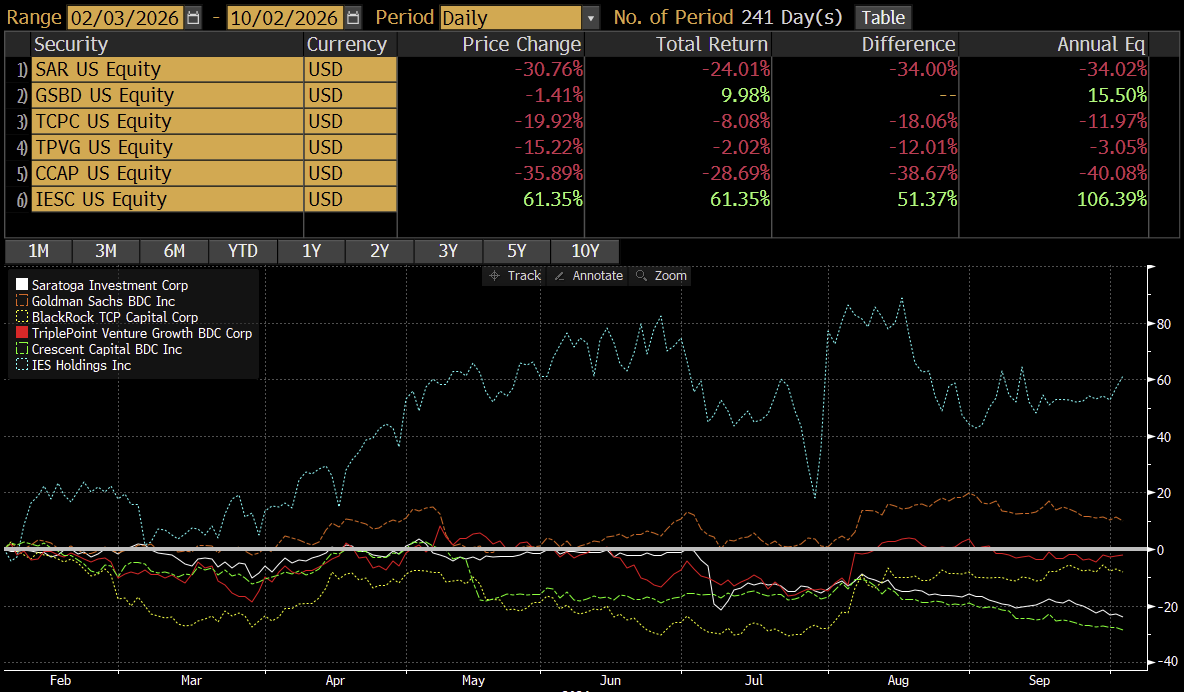
Since the article, IES is up 61% as earnings have boomed, while 4 out of the 5 BDCs have hit fresh lows after cutting dividends and writing off assets. There are plenty of cheap stocks, but most are cheap for a reason. With factor moves and AI risk increasingly whipsawing equities, I think selectivity is key and that it’s a stockpicker’s market.
In this Portfolio Review, I’ll be covering recent additions and removals to my Portfolio, my thoughts on the components within each of the five baskets: US Financials, Global Financials, Memory and Storage, Tech / AI Infrastructure, and Assorted Value, and the levels where I’m looking to add and reduce exposure to existing names.
Recap of Removals:
Before we get into the current Portfolio, I wanted to briefly touch on the trades discussed in the chat, and the reasoning behind each removal.
1. CBL Properties (CBL) +114% - Exited September 15, 2026
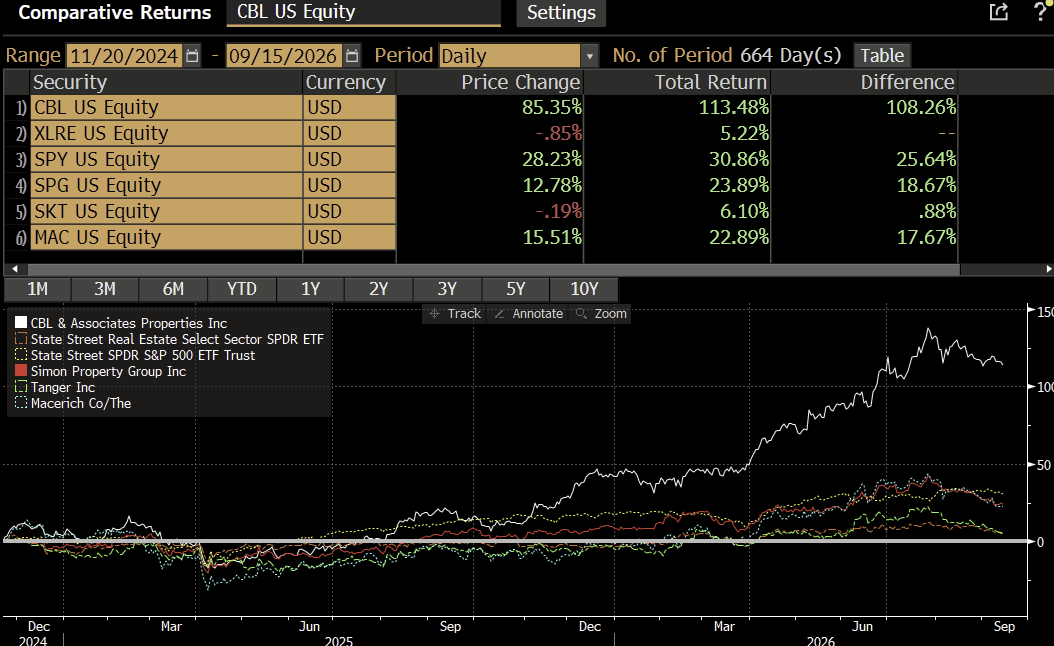
The CBL thesis has largely played out. After substantial refinancing activity, the disposition of land parcels and non-core assets, and steady repurchase activity and dividend increases, the market has become aware of CBL’s dramatic transformation and the stock has soared from a highly-distressed 4.5x FFO multiple to a reasonable 7.5x FFO multiple.
Given overall weakness in REITs, sizeable insider and significant holder selling, and the September interest rate hike increasing the burden of CBL’s large floating rate term loan, I believe CBL no longer resembles a value setup. With a roughly 4.5% dividend yield and limited repurchase activity at these levels, I think CBL essentially mirrors broader REIT exposure at best, which is something I am not interested in. It was a contentious name and the underdog thesis clearly proved itself, but at the current valuation I don’t see upside - I’m happy to cash it in and retain the proceeds for more attractive setups.
2. Heritage Insurance Holdings (HRTG) +17% - Exited July 29, 2026
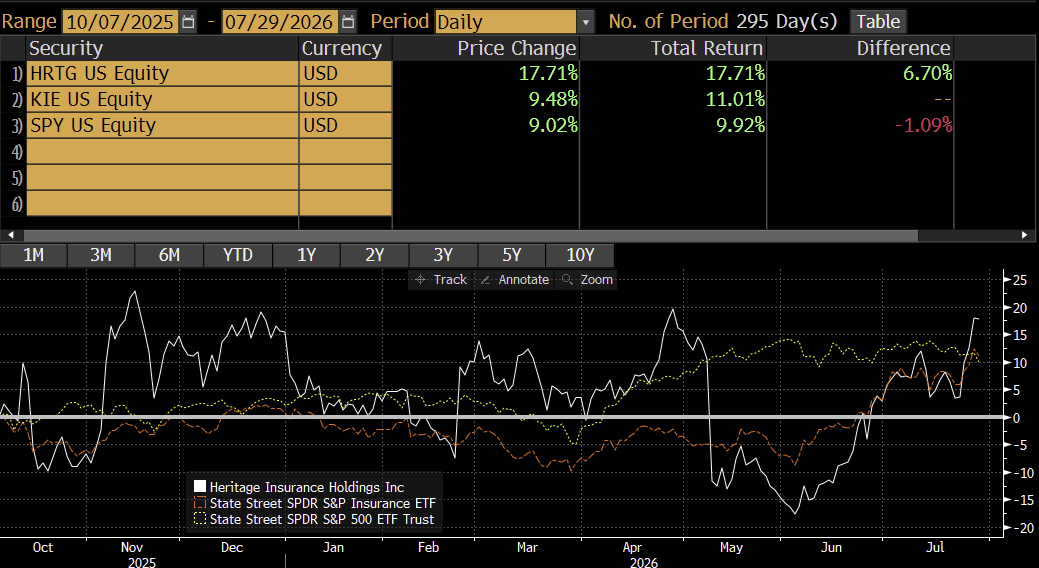
Heritage was originally featured in the “30 Days to November” piece almost a year ago. At the time, it was trading just over 5x earnings, with an immediate tailwind from no summer hurricane activity and significant growth opportunities in NY and CA. Since then, the company has executed well on its expansion plans and the stock soared during the June-August “flight to safety” as value names roared back. My sale was poorly timed, just a few days after selling in July, Heritage reported blowout earnings and soared to an all time high of 35 a share.
I have a lot of respect for Heritage, they have turned the company around from a 20 cent penny stock in 2022 into a well-regarded US Insurer with significant ties to FL, CA, and NY and the broader Northeast. There are very few insurers of Heritage’s limited size that have such significant geographic diversification and experience. Nonetheless, Homeowner’s Insurance competition is rapidly intensifying in FL and the US, I think the market is not yet recognizing the risk lower insurance rates pose to 2027 and 2028 results. Heritage is likely to crush the Q3 EPS estimate of $0.77 given there were no major storms and the loss environment was benign this quarter, so perhaps it’s worth considering a short-term earnings trade, but I’d only be interested in buying back in for the long haul at a bargain valuation, which is still just $25 a share.
3. Waterstone Financial (WSBF) +42% - Exited July 29, 2026
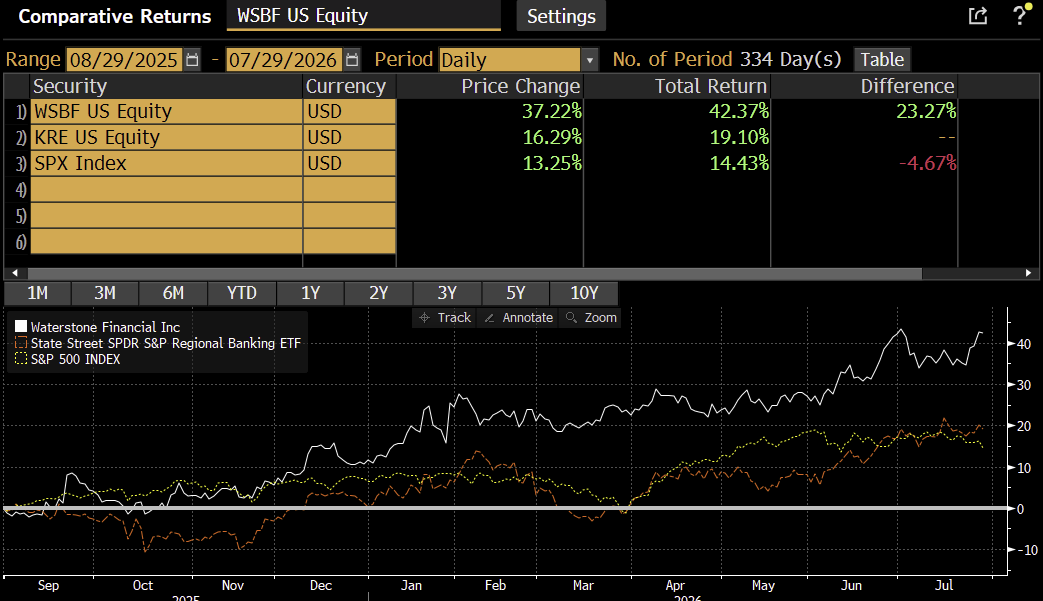
Waterstone Financial, a highly rate-sensitive Regional Bank, was originally featured in “Shifting Into Rates Down” on August 29, 2025. At the time, the stock was trading at a 25% discount to Tangible Book Value with a sizeable repurchase program, growing earnings, and a mortgage arm highly geared towards falling interest rates.
In July, Waterstone finally crept above its own Tangible Book Value, providing a pleasant exit opportunity after trouncing the broader regional bank benchmark by 22%. With historically limited repurchase activity above Tangible Book Value, and higher interest rates impacting its Net Interest Margin and slowing underwriting opportunities for its Mortgage Arm, I think it’s time to let it go. Since July, despite the stock’s strong performance, mortgage rates have surged into the 7 - 7.50% range, which is going to severely dampen the Mortgage arm in Q4, and Real Estate activity across the country. Waterstone isn’t a name to forget, however. Chances are it becomes a strong buy once mortgage and interest rates finally begin to decline, and I’ll be keeping it on my watchlist as a “Rates Down” name for this scenario.
4. Farmer Mac (AGM and AGM/A) +30% - Exited July 27, 2026
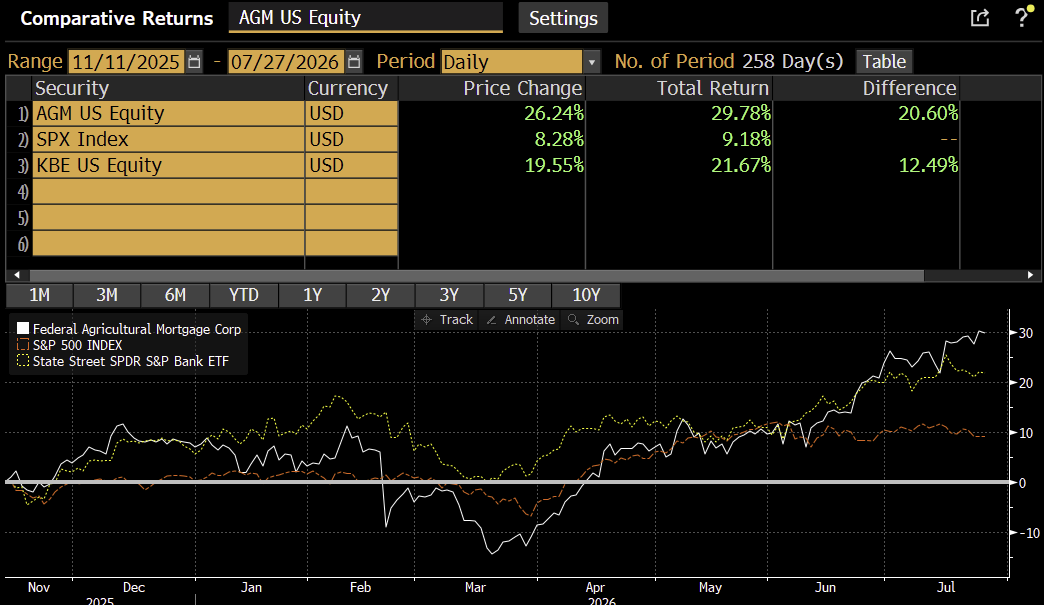
Farmer Mac is a privately owned Government Sponsored Enterprise (GSE) that purchases and guarantees agricultural loans. At the time of position entry, AGM was trading at just 8x earnings (a historical 10 year low), amidst credit quality concerns which prompted a huge plunge in the stock. Since then positive results have soothed concerns - credit quality has stabilized, the dividend was increased, and AGM flexed its share repurchase capabilities in the $160 - $180 range. In typical fashion, the stock jumped a further 12% since the sale, but I’m happy with the exit. AGM historically trades within a stable band of 8x - 12x earnings, and closer to 8x or 9x earnings in the $180 - $190 range I will happily re-enter. Contrary to popular belief, AGM is one of the best performing financials names over the last 10 years, generating an annualized return of 21%, way ahead of peers and the S&P. I believe an attractive level to watch is $180, which represents a long-term opportunity.
5. Ategrity Specialty Insurance (ASIC) +39% - Exited September 28, 2026
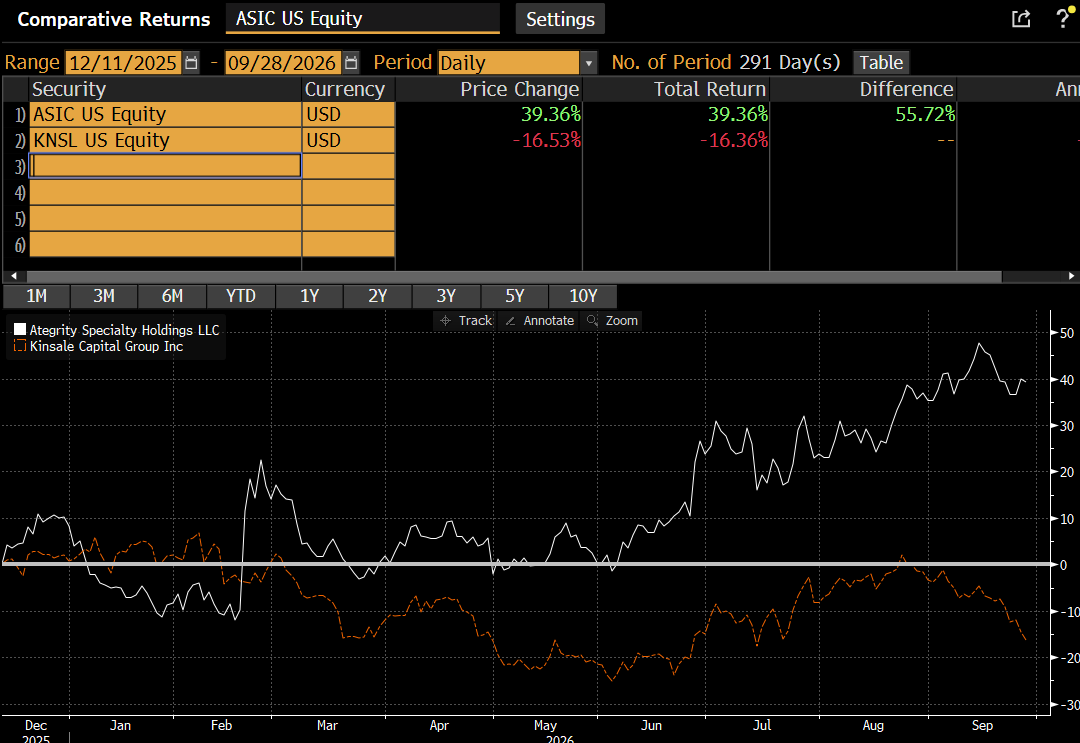
Ategrity Specialty insurance was originally featured last December as a pair trade against its well-known peer, Kinsale Capital Group. Since then, Ategrity has defied industry headwinds, generating Gross Premium growth of around 25%, 20% ahead of the industry.
With the stock now trading at 15x earnings I think the valuation has gotten lofty. It’s possible Ategrity becomes the new “growth darling” as investors look for faster growing opportunities within insurance, but I also think you need to contextualize the valuation with the broader overall trend: Excess and Surplus lines growth has slowed from 15% in 2025 to just 3% YTD in 2026, a significant deceleration. At 10x earnings with 25% growth it was an easy entry, but at 15x earnings with a huge industry headwind, I just don’t feel comfortable holding it. There are plenty of other Portfolio positions at a single digit multiple with significant share repurchase activity, I’d much rather allocate to them than hold Ategrity and hope momentum continues driving it higher.
6. Entravision Communications (EVC) +171% - Exited August 21 Via Options
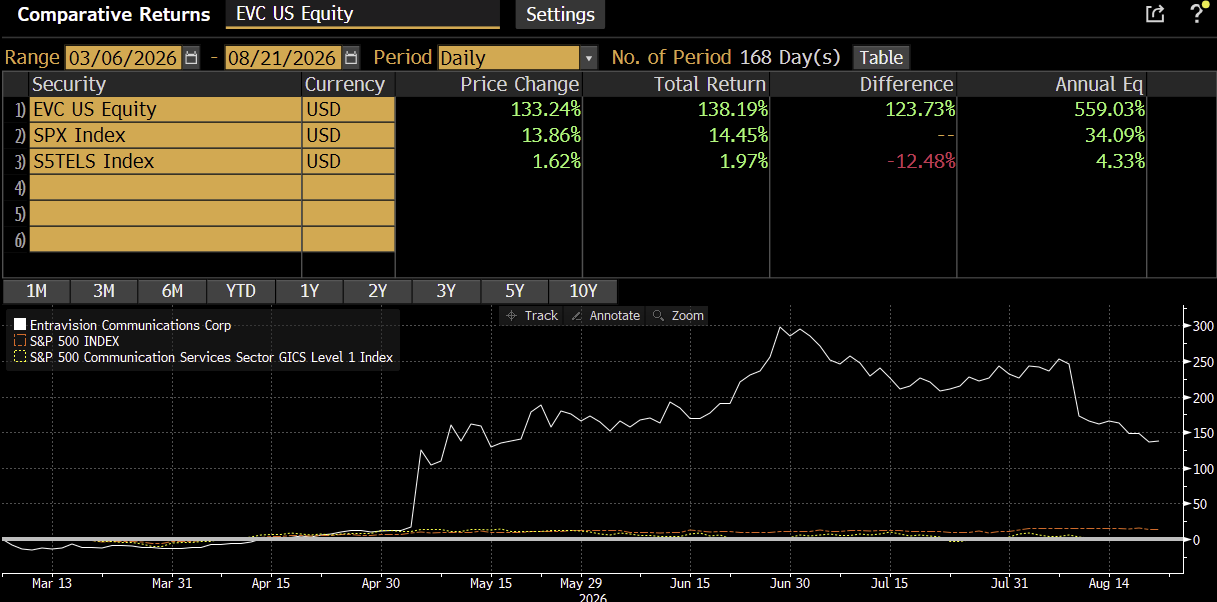
Entravision was trading at a 7% dividend yield with essentially zero value ascribed to its rapidly growing advertising segment, Smadex, at the time of entry in the March Portfolio review. Since then, Entravision has reported 100% YOY growth and great operating leverage, but the stock fell below the $10 August protective puts I purchased and was subsequently closed out.
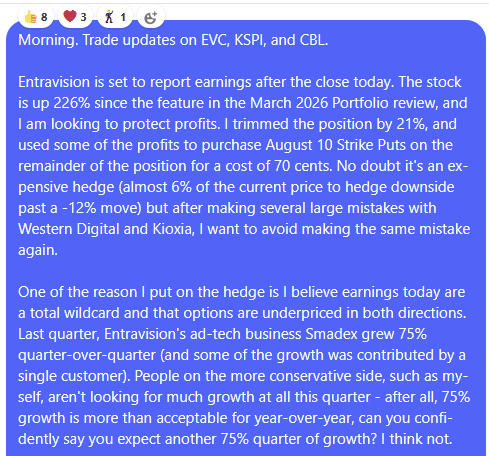
(Excerpt from the August 10th earnings Note)
One of the reasons I like purchasing put protection is that it holds you accountable, and additionally, for small caps, it’s the only way to have a defined exit strategy. Stop orders are unusable for earnings since they could trigger after hours and lead to wild execution, and more importantly, a put position provides an extra line of defense against negotiating with yourself. Unlike a literal or mental stop (which you can easily adjust), a long position paired with a put sets clear time and price conditions on how much leeway you are willing to give.
Either the name you own starts behaving properly, or it’s removed and you move on at options expiration.
In this instance, after riding Entravision up from $3 a share to $13 only to see it fall precipitously from $11, I trimmed 25% of the position prior to earnings and used a portion of the profits to eliminate downside risk below $10. Despite very impressive results, Entravision’s conservative guidance for Q3 wasn’t enough to impress the market, and by mid August it was trading at $8.50, sharply below the $10 Strike Puts and was “put away”.
I will discuss in further detail below, I’ve put on a similar protective put trade on Western Digital. Despite the stock being up 120% YTD and contributing heavily to returns, it’s down 44% from its June highs, and simply isn’t performing like Micron, Samsung, and Hynix. There’s a limit to how much of a drawdown I’m willing to take, and Western Digital is nearing that pain point.
Back to Entravision, the stock has since drifted down into the low 7s, and is starting to look interesting. Will give it a closer look towards earnings, which should be reported in late October.
7. Powell Industries (POWL) +136% - Exited August 21 Via Options
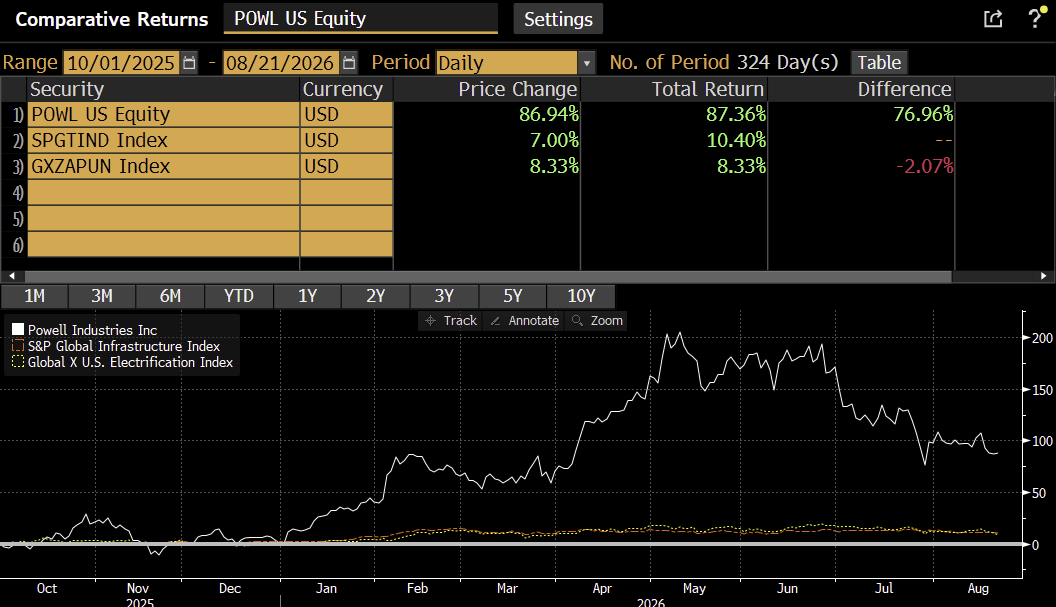
My favorite way to hedge the AI Infrastructure names (FIX and IESC, formerly Powell) is via costless collars. Almost all AI Infrastructure / Electrification names exhibit positive skew going into earnings, which means you can substantially reduce downside and cap upside by purchasing puts and selling calls, usually at a small credit provided the strikes are equally distant.
AI Infrastructure basket components regularly exhibit a stairs up, elevator down pattern, which made continual collars ideal. Comfort Systems and IES Holdings were able to quickly rebound in August after a huge liquidation within the AI trade, whereas Powell wasn’t able to stay within the 250 / 300 Collar after disappointing earnings.
Normally, if collared names are somewhat close to the bottom range of a collar, I’m willing to cash the put in to keep the trade going. In this case, Powell was 30% below the $250 Put, and was also trading above 35x earnings with disappointing growth numbers, while IES traded below 25x earnings with 35% growth. I let the Powell position get put away at options expiration to add more firepower for adding IESC near $300.
8. Vistance Networks (VISN) -20% - Exited August 6
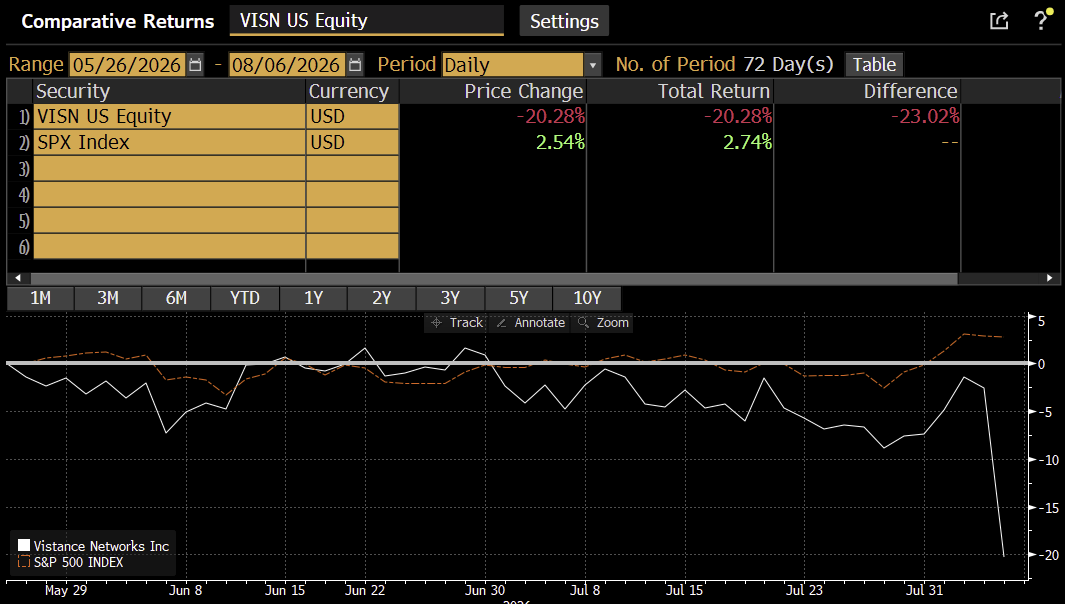
I originally pitched Vistance back when it was still known as Commscope in 2024, but because I re-pitched in May I think it’s only fair to refer to the more recent entry point.
I didn’t like the commentary on the Q3 call that Vistance is eating a chunk of higher memory prices rather than passing the entirety through to their large cable customers. Ultimately, despite Vistance’s extremely cheap valuation, I think high memory prices will be an issue for years and a large negative for the company unless it starts passing through these costs. I cut the loss at 21%.
9. Hello Group (MOMO) -21% - Exited September 10
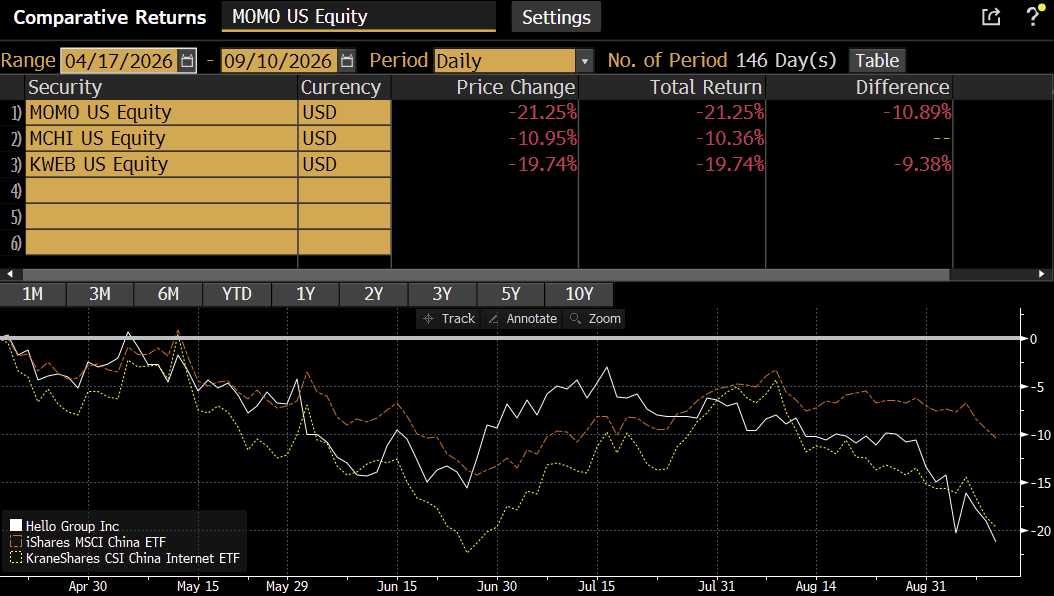
Hello Group is a melting ice-cube, a Chinese dating app owner with a huge cash balance (almost $8 a share), a growing portfolio of International apps, and a cash-cow portfolio of domestic apps in steady decline.
Hello Group’s June results showed strong growth in their International Portfolio and upbeat sentiment which kept me interested, but their September report was a significant departure from June: International app growth slowed, and the 2027 International growth target was lowered.
With few, rare, exceptions, I exit new positions when they hit a 20% loss. Despite MOMO’s significant discount to its own cash balance and relatively compelling fundamentals, I think the overall decline in China Internet related equities (KWEB) and the prospect of tax-loss selling by individual investors towards the end of the year creates a difficult backdrop to stay invested. I took the 21% loss, and may revisit the stock early next year if International Growth gets back on track.
10. SK Square (402340) +44% - Exited October 1
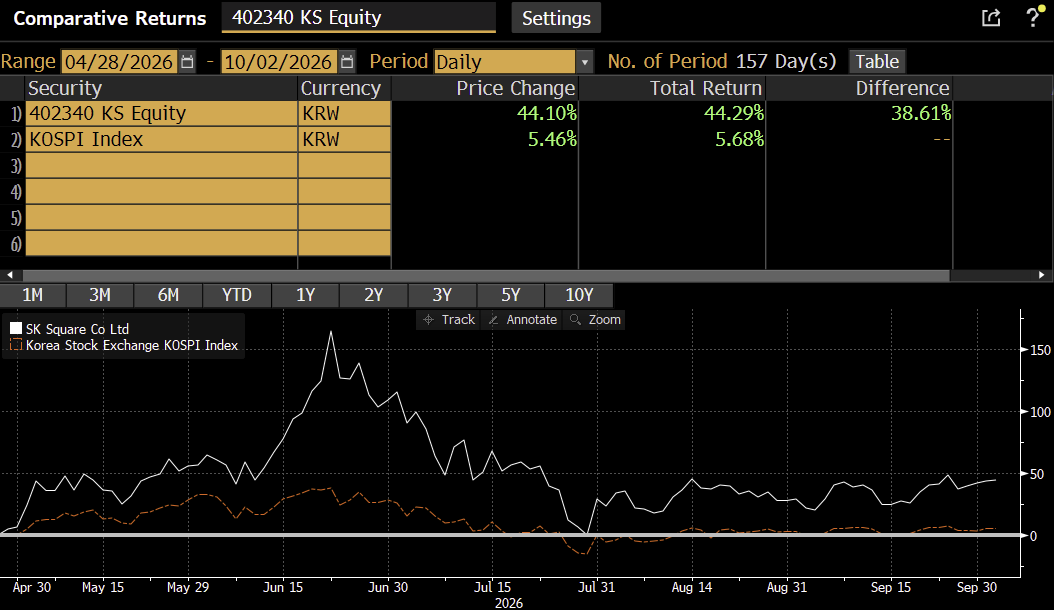
SK Square was the first Korean stock I purchased on IBKR back in April. I remember sitting at my screen at 2:10 AM EST in late April the day IBKR launched Korean Equities, continually typing Korean tickers into TWS, none of them would appear as symbols. Eventually, SK Square loaded and I was able to buy.
It’s been a nauseating ride ever since. My initial 2% of NAV investment ballooned into a 150% gain, before crashing right back to cost basis in August and since recovering to +44%. I’m not turning into a Memory bear, and it’s undeniable that SK Square is the cheapest way to get exposure to Memory given it trades at a 45% discount to the value of its Hynix stake, which itself is just around 4.5x 2027 Earnings.
Still, after the events of July, there’s a limit to how much Memory and Storage risk I’m willing to take, and that’s a very firm 25% of my Portfolio. With the recovery of Hynix, Samsung Preferred, and Micron over the past couple of weeks (no thanks to WDC), I was once again above that 25%. Given the smaller gain in SK Square relative to the other basket positions, I sold SK Square. If I was approaching this from a fresh slate and had no exposure to Hynix, I would certainly consider SK Square for memory exposure.
As I’ll discuss below, of all the components within the Memory and Storage Basket (Samsung Preferred, Hynix, Western Digital, Micron, and Kioxia), Samsung Preferred is still my favorite given the sizeable discount to the Common Shares, and Samsung’s variable dividend approach, which creates a direct cash incentive to own the Preferred Shares over the Common, as opposed to a buyback which might benefit the Common with minimal impact on the Preferred.
11. Global Medical Response Solutions (GMRS) +10% - Exited July 2
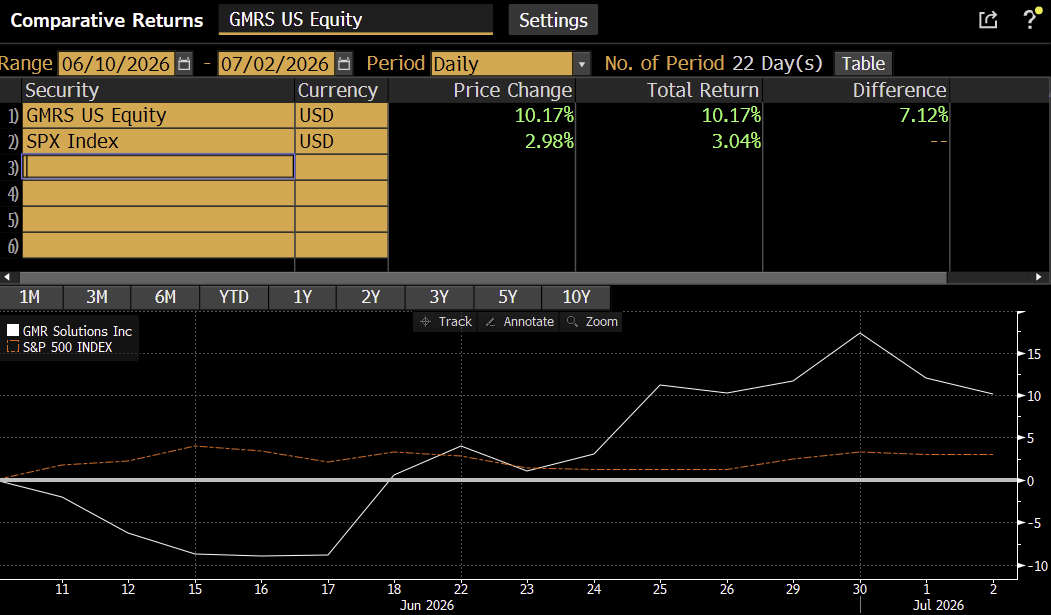
Global Medical Response is America's largest privately owned ambulance and air transport company. The IPO flopped horribly, and the shares dropped from $15 to just $10.50 in weeks. After several lofty initiations of coverage (GS at $30, UBS at $20), a short-term setup presented itself, and the position was quickly closed after the initiations of coverage attracted Institutional attention.
Interestingly, the stock has entirely retraced the rally and is once again hovering around 7x earnings, but I think caution is warranted. GMR is highly levered, and has indicated it will use its earnings to pay off its sizeable debt load. Until a shareholder friendly dividend or repurchase plan is announced, I will be watching from the sidelines.
The removal of these eleven names has freed up a lot of dry powder, and my cash pile is now sitting at roughly 25%. I’d like that figure to be a bit lower, but with interest rates going haywire and midterm mayhem just beginning to kick off, I don’t mind waiting a few weeks, or even months to get that money to work. As with all of the single-name articles I’ve posted on this blog, International General Insurance, CBL Associates, Oppenheimer Holdings, Chain Bridge Bancorp, and Customers Bank, what made them work was the entry point. Rather than put all that “cash to work” immediately, I’d rather closely follow names I’m interested in, and wait for an attractive entry point to bet big.