

Disclaimer: By reading this article, you acknowledge and agree to the terms and conditions
It’s Not Just the Size of the Buyback, It’s Why It’s Used
These days, everyone seems to be leaning on buyback announcements as convincing evidence something they like is undervalued. “So-and-so will repurchase x% of its market cap by 2028, how can the market be missing this?” To be fair, the people who say this, whether they know it or not, have stumbled upon something interesting: factor data shows that equities that rank among the top quintile for share repurchases routinely outperform the broader market over the long run.
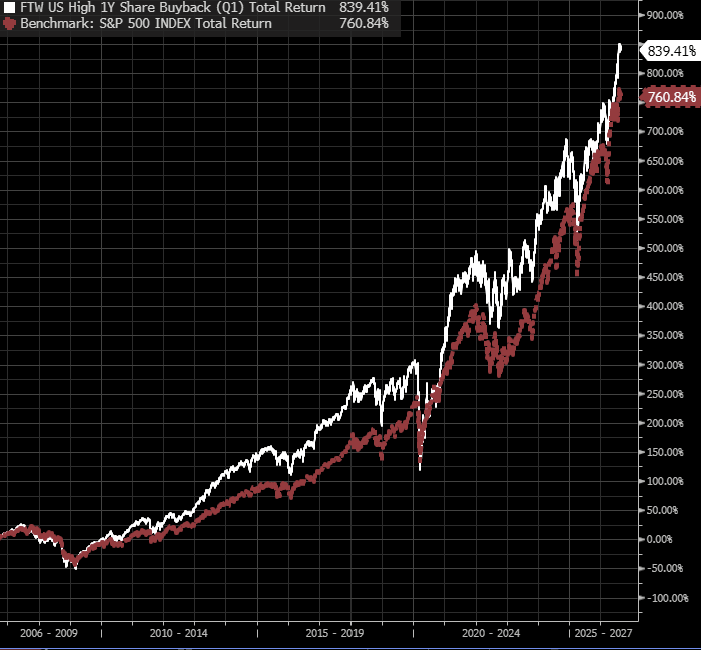
Over the last 20 years, US Top Quintile repurchasers returned 839% versus 760% for the S&P Index (pictured above), Japanese Top Quintile repurchasers returned 543% versus 290% for the Topix Index (pictured below), and Chinese Top Quintile repurchasers returned 435% versus 139% for the HSI Index (also pictured below).
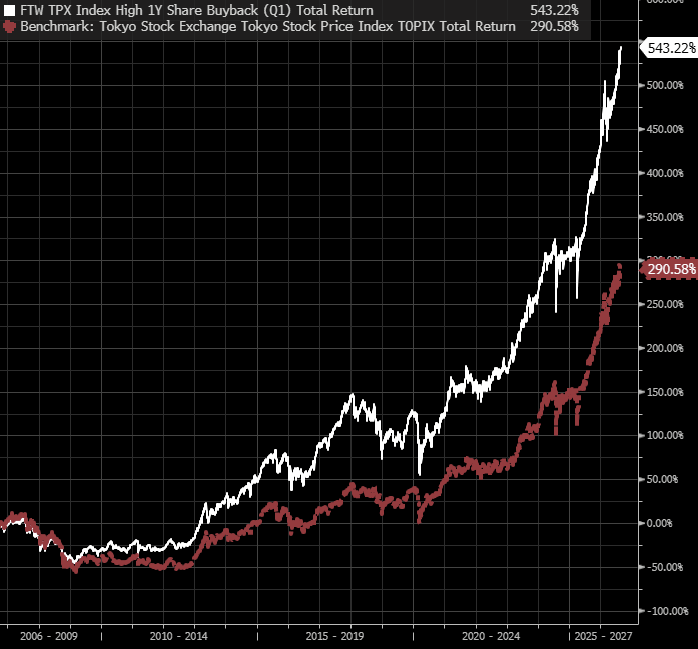
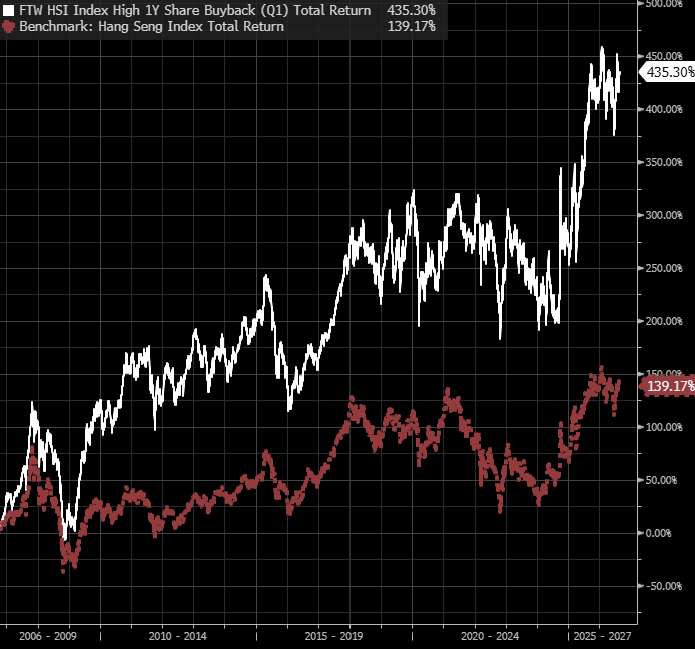
There are many factors in addition to repurchases that likely contributed to this outperformance (such as sector mix), but one thing is clear: the buyback factor packs a punch.
Does this mean you should blindly follow the gospel of “share cannibals”? I think not. Instead, I think it makes sense to contextualize buybacks and ask yourself “why is a company suddenly buying back its shares?” The answer can help you separate value traps (names in secular decline using share repurchases to prop up results) from value trades (inflecting businesses with strong balance sheets and aligned insiders who use repurchases as a tool to distribute excess cash and maximize value).
Since I started this blog in 2025, I’ve written up 5 names with quality fundamentals, broad tailwinds, highly aligned insiders, and significant share repurchases to close discounts to peers.
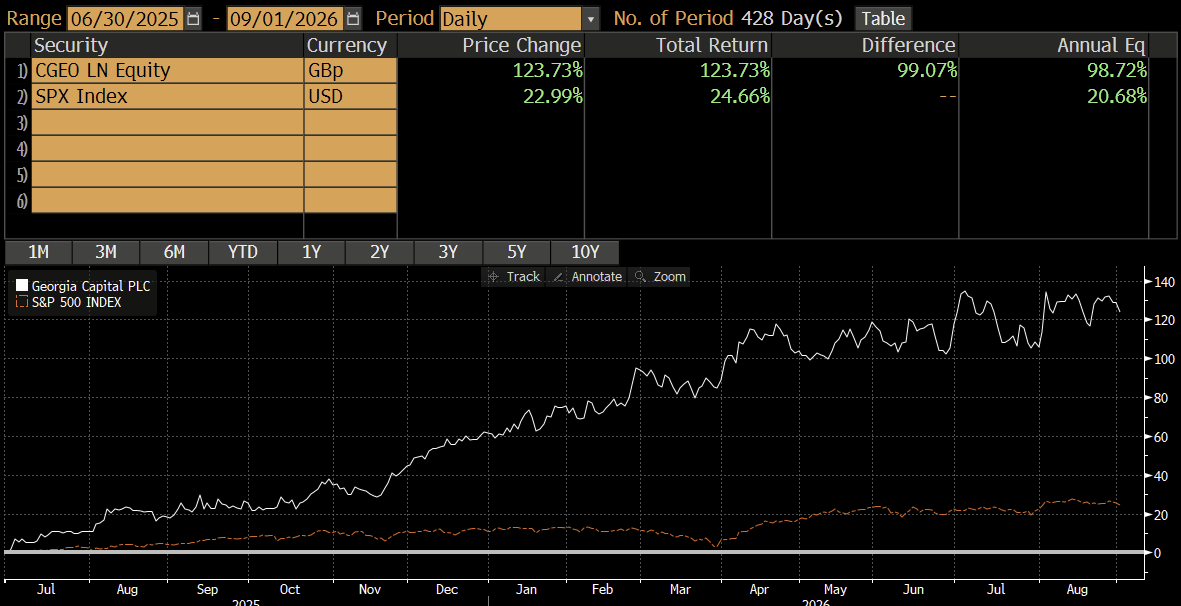
The first trade was Georgia Capital (June 30th, 2025 Identifying, Structuring, and Sizing A Value Trade), a Georgian Investment Firm trading at a steep discount to the value of its publicly listed bank stake and its private hospital, pharmacy, utility, and insurance subsidiaries. The earnings were consistent, the management team was heavily aligned (share ownership of $150 Million at the time versus $4 Million in executive compensation), fundamentals were improving, and importantly, the company made a strong case that it was undervalued and that it would direct cash into repurchasing shares until a more reasonable multiple was attained. The company has steadily repurchased 2.5% of the float each quarter since June 2025, and the stock is up 123% versus 24% for the S&P.
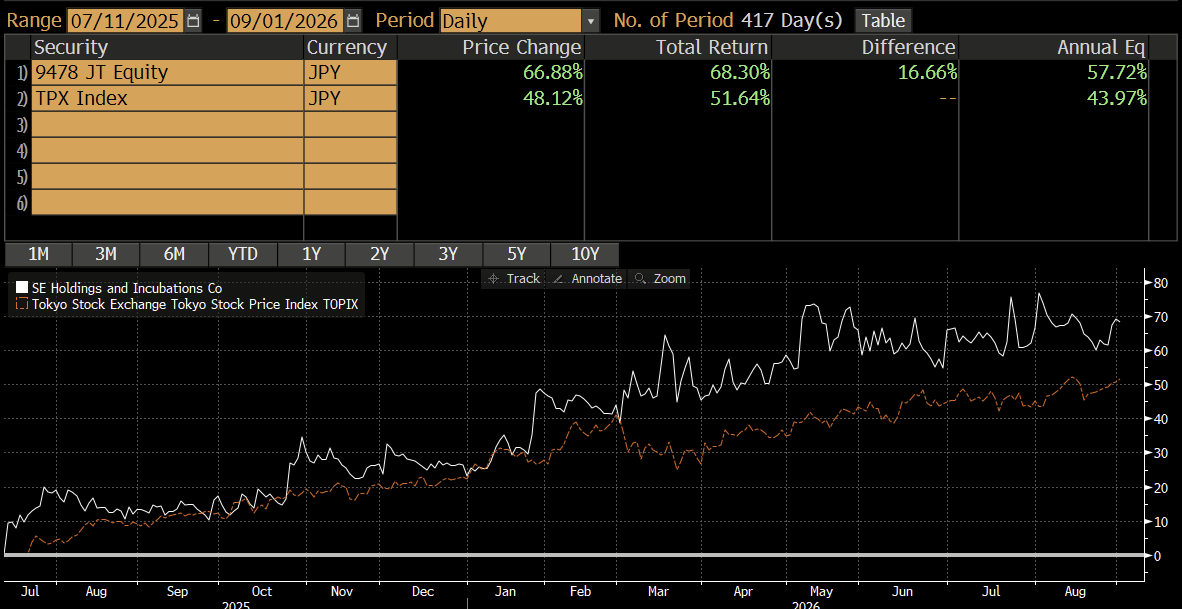
The second trade was SE Holdings and Incubations (July 11th, 2025 A Value Investor's Paradise), a small Japanese publisher trading at a significant discount to its cash and global securities portfolio. As global markets continue to rally, SE has shrewdly used dividend and interest income paired with its publishing profits to aggressively repurchase 15% of the float each year. Despite the stock rallying 68% since the pitch, SE still trades at the exact same 0.62x Price to Tangible Book Ratio simply because book value has grown just as fast as the share price.
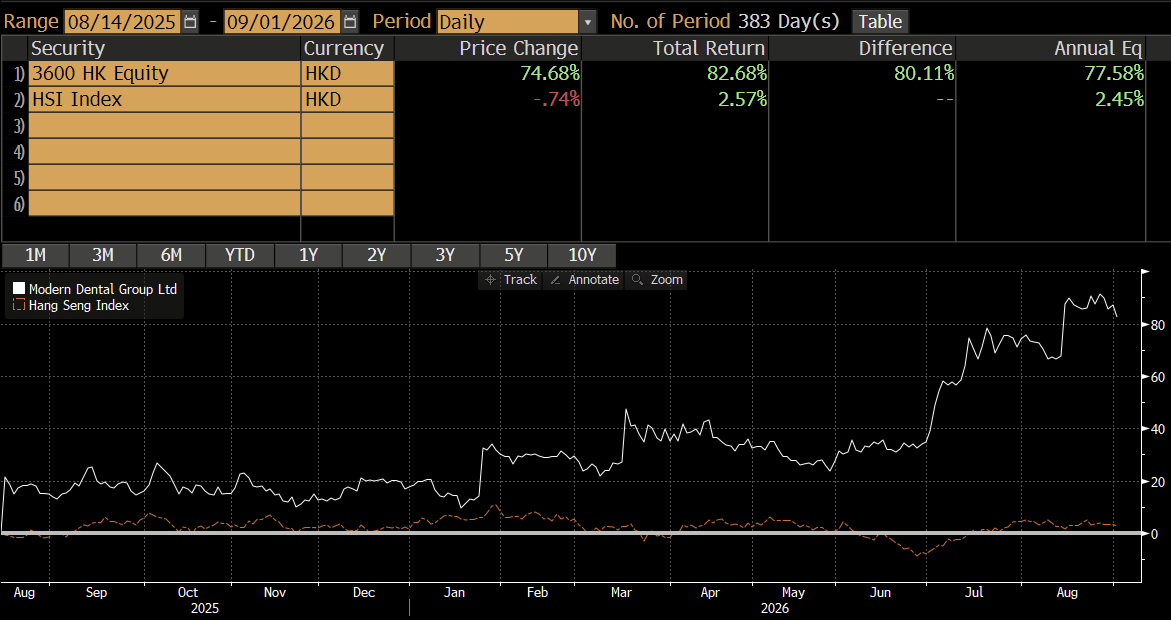
The third trade was Modern Dental Group (August 14, 2025, Juicing the Market), a leading global manufacturer of dental prosthetics and implants operating a network of 80 labs across Europe, the United States, Australia, and China. Unlike traditionally shareholder-unfriendly peers, Modern Dental Group has distinguished itself by using cash to roll up global competitors while also steadily increasing its dividend and opportunistically repurchasing shares. Earnings have roared 50%, and the stock is up 82% since the pitch versus 3% for the benchmark HSI Index.
The final two trades were Bank of the Ryukyus and Jurokou Financial Group (August 14, 2025, Juicing the Market), two highly rate-sensitive Japanese Banks who astutely understood they could build shareholder value by increasing capital returns. In a literal sense, Bank of the Ryukyus and Juroku announced an aspiration to re-rate from 0.3x Tangible Book to 1.0x Tangible Book, and promptly started repurchasing stock and increasing their dividends.
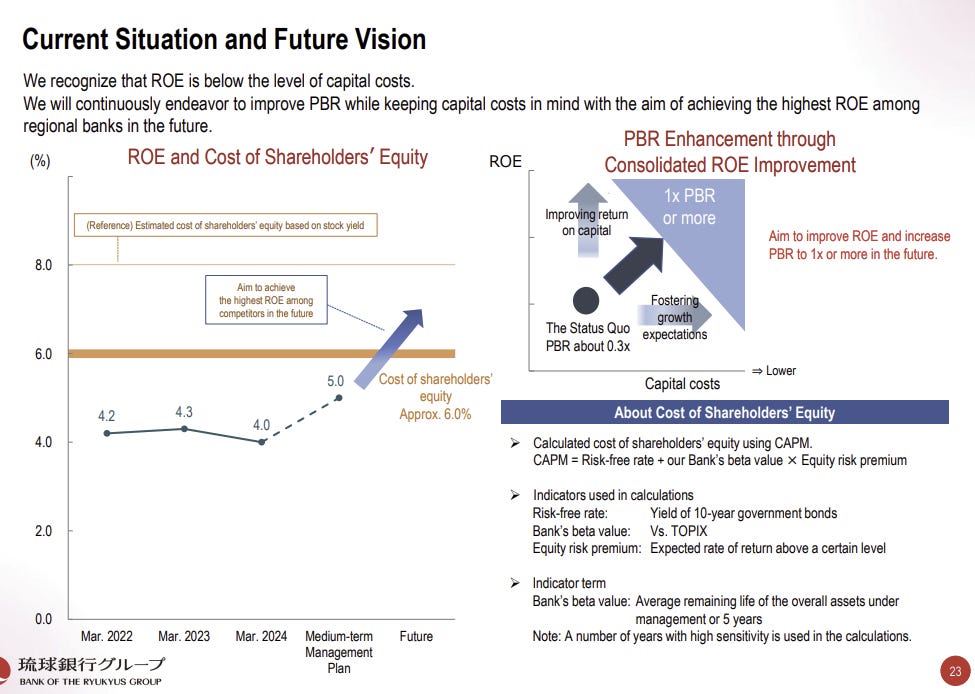
(Bank of the Ryukyus Summer 2025 Investor Presentation)
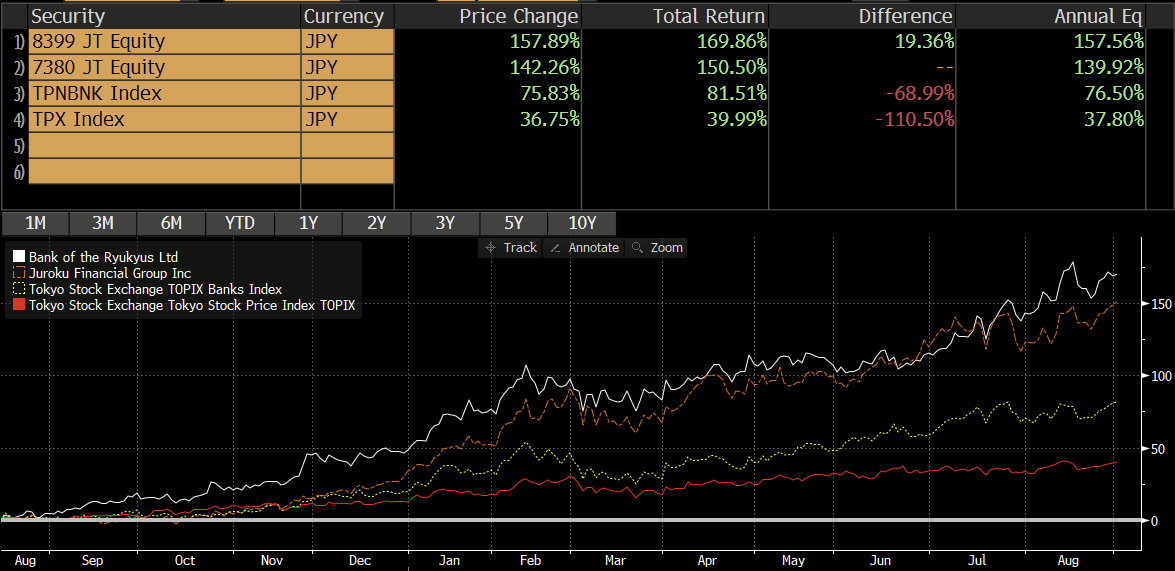
Fast forward a year, and Bank of the Ryukyus has rallied 169% and Juroko Financial Group has soared 150%. Both names are up double the Topix Bank Index (81%) and quadruple the Topix (40%), as shareholder friendly capital allocation gave them an edge over more conservative peers.
I don’t mention these returns to gloat, rather, I want to show it’s possible to generate outsized returns on boring businesses by using buybacks as a simple filter to weed out the value trades from the value traps. This isn’t to say you can’t make money from hail-mary value setups where a binary catalyst like a takeover or drug approval is the deciding factor, but I’d much rather ride along with aligned management teams buying back shares at inexpensive multiples.
All five of these trades shared identical characteristics: quality earnings, aligned insiders, favorable tailwinds, and shareholder friendly capital allocation that convinced the market “locked up” value was finally being returned. On a side note, if there was ever a time to say “Past Results are Not Indicative of Future Performance”, it’d be here. (Past Results are Not Indicative of Future Performance.)
These days, it’s hard to find similar trades with the market near all time highs. Plenty of names are optically cheap, but “it’s less expensive than the S&P” doesn’t cut it for me.
I’ve increasingly been looking towards Asia and Europe; newfound management attentiveness to cost of capital and regulatory reforms to penalize bad actors have gently nudged many value traps in the right direction. In this piece, I’m covering 3 global setups across Korea, Japan, and the EU: a capital-light Korean insurance brokerage, a shareholder-friendly Japanese manufacturer with a sizeable cash balance, and a niche European asset manager with record investment returns. All three blend together the framework: strong earnings, aligned insiders, favorable tailwinds, and concrete shareholder return programs that ensure the value being created is rapidly paid out.
Trade 1: “Capital-Light in Korea”
Long: A Plus Asset Advisor (244920 KS)
Price: 13,100 KRW
Trailing P/E: 9.7x
Forward P/E: 9.0x
Price to Tangible Book Value: 1.84x
Shareholder Return Yield: 5.29% (Share Repurchases - 3.0%, Dividends - 2.29%)
Insider Ownership: 27% (Additional 21% in Activist Ownership)
2027 Price Target: 14,500 KRW
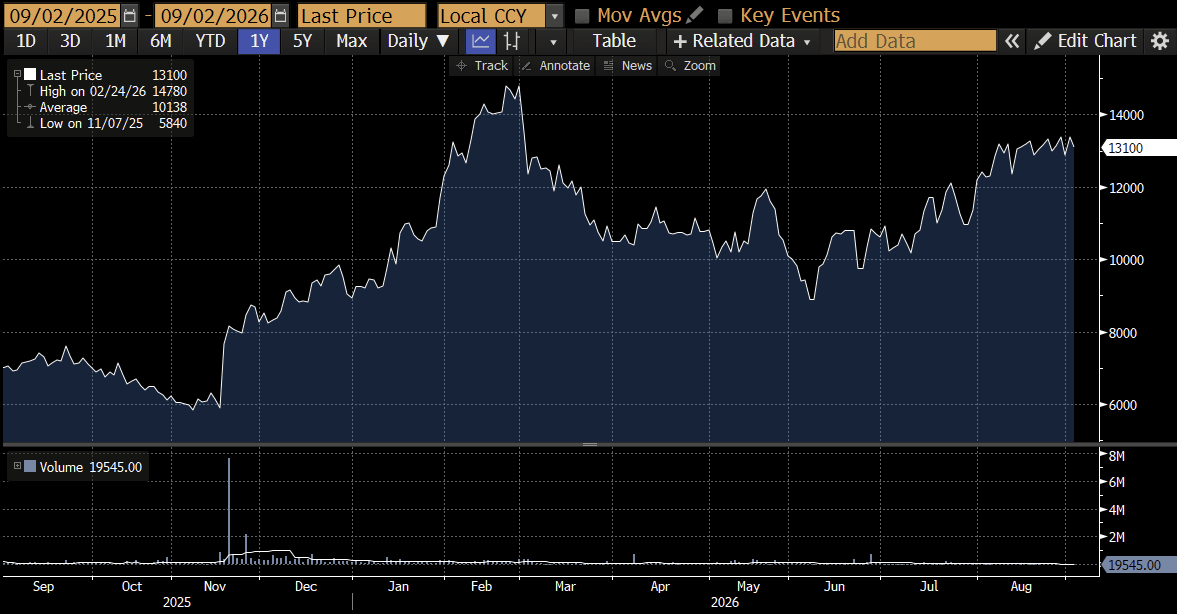
A Plus Asset Advisors is a capital-light Korean insurance brokerage poised to benefit from two structural tailwinds: increasing consumer preference to purchase insurance via independent general agencies (as opposed to captive agents who only sell insurance policies from one company), and the Korean Financial Services Commission’s crackdown on aggressive insurance agents. A Plus was founded by Geun-Ho Kwak (27% ownership), a former Samsung Life executive, and has rapidly grown and become Korea’s second largest publicly listed general insurance agency.
A significant portion of Korea’s insurance market are “long-term protection policies” that carry high commissions for the agents who sell them (sometimes amounting to 1,200% - 1,500% of the first monthly premium). As these policies surged in popularity, a perverse incentive grew where agents would frequently switch clients to different policies, or sell them new policies they didn’t need, to maximize commission revenue. In 2021, the Korean Financial Service Commission finally took action, capping commission payments to GAs (general agencies such as A Plus) to 1,200% of the first monthly premium. The crackdown heavily impacted earnings, and A Plus’s share price declined from 12,000 in late 2021 to just 4,000 in early 2023.
The Korean FSC has continued its crackdown, regulating agency compensation policies and making the 1,200% cap apply to smaller agencies. Recently, the FSC has finally brought the hammer down, declaring that these restrictions would apply to all agencies and individuals, essentially wiping out the livelihood of individual agents. While the 2021 crackdown represented short-term pain for A Plus, it has since translated into long-term gain. The commission and compensation regulations have established significant barriers to entry and have destroyed the compensation model of A Plus’s less scrupulous peers, forcing smaller agencies and independent agents to search for a new home. Many of these smaller competitors have since been folded into A Plus.
A Plus’s insurance agent headcount has steadily increased from 4,423 in 2023 to 5,227 in 2024, 6,908 in 2025, and 8,897 in 2026, a CAGR of 26.23%, and its insurance brokerage operating profits have surged from 9.1 Billion KRW in 2021 to an all time high of 37.67 Billion KRW in the trailing 4 quarters (21% growth relative to the comparable period from 2024 Q3 to 2025 Q2).
Simply put, what was originally a headwind for A Plus is now a significant tailwind. This isn’t to say further regulation can’t dampen results (the FSC plans to have insurance broker commissions spread out over a multi-year period starting in 2027), but the bottom line is heightened regulation now entrenches giants like A Plus against new entrants, and A Plus stands to gain from further headcount additions as individual agents go out of business.
I’m attracted to A Plus’s history of success and its clean track record. Unlike its more cheaply valued peer, Incar Financial Services (6.5x forward earnings) who was hit in June with a FSC Penalty for forged insurance contracts and several regulatory violations, A Plus’s highly centralized brokerage continues to onboard new agents and new business with minimal fanfare. Whether you are a customer or investor in a financials business, you simply can’t put a price on regulatory compliance and trust.
A Plus trades at roughly 9x earnings, which I believe significantly undervalues its cash-cow, diversified, brokerage business (global peers trade in the 16x - 22x range). A Plus has more than 34 insurance partners, and processes a steady mix of P&C and Health Insurance (75%), Life Insurance (20%), and Excess Liability Insurance (5%) that diversifies its fee stream from changing insurance rates. Unlike capital heavy banks or insurers who may trade at similar multiples with left-tail risk (catastrophe events or credit risk), A Plus’s diversified fee-based income stream comes with minimal strings attached.
A Plus is also a glass half full setup - there is still substantial work to be done as the company transitions itself from value trap to value trade.
Nearly 25% of A Plus’s assets are concentrated in its breakeven funeral business, and the company also owns a nearly 40 Billion KRW stake in a medical device manufacturer. These random subsidiaries overshadow the tremendous ROE present in A Plus’s core insurance division (which accounts for 95% of operating income), and have angered activist investors, who rightly assert there is significant value to be unlocked by disposing of these non-core segments.
In December 2025, Korean value fund Align Partners purchased a 5% stake via a block transaction, and increased their stake to 18% via a tender offer at 9,000 KRW and open-market purchases. The fund demanded A Plus commit to dividend increases, share repurchases, establish a “Value Up” program to improve shareholder value, dispose of non-core assets, and approve Align’s two independent director nominees.
Founder Geun-Ho Kwak responded by rapidly increasing his stake in the company, and rallying individual investor support around his nominees. Although A Plus’s management team won the vote narrowly in the April Annual Meeting (58% - 42%), Align Partners ironically got some of what they wanted.
A Plus published a Value Up program (with a pledge to establish a more concrete dividend policy in the second half of this year), raised the dividend 50% to 300 KRW, and launched its first-ever share repurchase program to acquire and cancel 3.00% of shares outstanding (the repurchase program is currently buying back about 10,000 shares a day, 25% of the ADV and 8 bps of the float, providing significant support). Interestingly, Align Partners has further increased their position to 21% of shares outstanding in June and July, indicating they are here to stay.
What I like about A Plus is that it is inexpensive relative to global standards, is capital light, has highly aligned insiders (the Kwak family owns 77 Billion KRW relative to compensation of just 1.5 Billion KRW), and is finally taking steps to unlock shareholder value and treat shareholders like partners, not enemies. The dividend increase and share repurchase program are an excellent step in the right direction, and there is still so much more to be done - a disposal of its funeral business or the divestment of its medical equipment stake would provide a cash bonanza to further reward shareholders.
A Plus is a prove me story similar to IGIC back in 2023-2024, Kaspi in 2025-2026, even Georgia Capital in 2025. It’s not a perfect name, but the valuation reflects this and the alignment, fundamentals, and improving capital allocation fit the Value Framework well. I believe the 13,000 KRW to 13,500 KRW range at 9x forward earnings represents an attractive entry range for a starter position if you find the pitch interesting, and that it makes sense to retain firepower to add on further positive developments or shareholder return announcements.